English
  العربية
  中文
中文
 Deutsch
 Türkçe

 日本語
日本語
How Can Urban Roadway Lighting Become More Resilient to Extreme Weather?
Extreme heat, heavy rainfall, thunderstorms, and strong winds can place enormous pressure on urban infrastructure during the summer months.
High temperatures may increase electricity demand and affect the efficiency of transformers, power lines, and distribution equipment. Heavy rain and flooding can damage underground cables and electrical cabinets, while lightning and strong winds may cause line trips or local power outages. According to the International Energy Agency, extreme weather can affect electricity generation, transmission and distribution networks, and power demand at the same time, making climate resilience increasingly important for modern power systems.
For roadway lighting, this raises an often-overlooked question: when the grid is disrupted, can a city still maintain essential lighting on its most critical roads?
From Equipment Protection to System Resilience
Outdoor luminaires are traditionally designed to withstand harsh environments through ingress protection, thermal management, corrosion resistance, and surge protection. These characteristics remain fundamental to reliable operation during extreme heat, heavy rain, and thunderstorms.
However, a luminaire that survives severe weather does not necessarily guarantee that the lighting system will remain operational.
If an upstream transformer, control cabinet, or power line fails, an entire section of roadway may go dark even though the luminaires themselves remain undamaged. This becomes particularly problematic during heavy rain, flooding, and low-visibility conditions, when drivers and pedestrians need to identify road boundaries, standing water, obstacles, and intersections.
Large-scale lighting outages can also complicate evacuation, emergency vehicle access, field inspection, and repair work.
Roadway lighting therefore needs to move beyond the reliability of individual luminaires and consider the resilience of the entire system. In this context, resilience does not mean preventing every possible failure. It means maintaining essential functions after a disruption and adapting operations as conditions change.
Maintaining Essential Lighting on Critical Roads
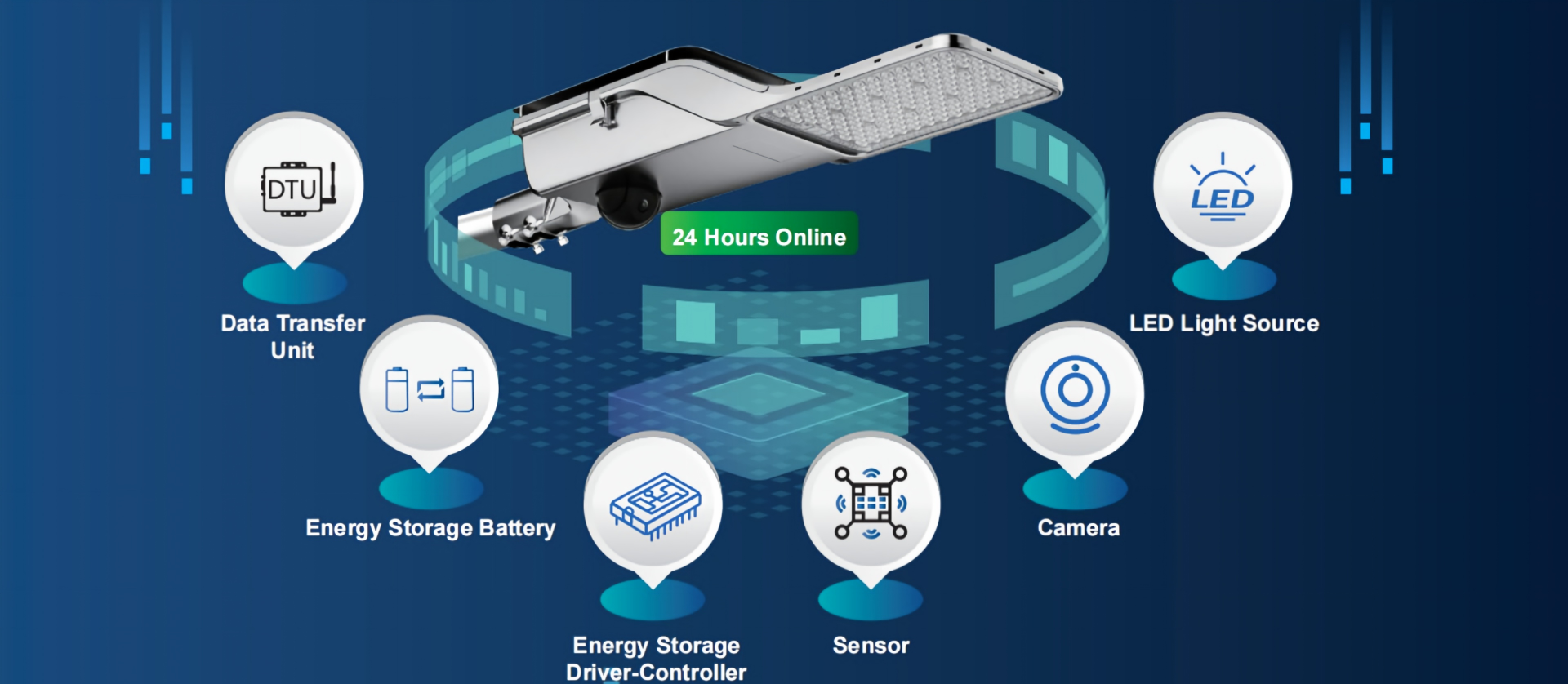
Conventional roadway luminaires rely on the grid for their power supply and may stop operating when a grid outage or serious electrical fault occurs. Emergency Energy Storage Roadway Lights address this vulnerability by integrating a dedicated battery module and an energy storage driver-controller into the lighting system.
Under normal grid conditions, the luminaire operates on mains power while the battery is charged and its condition is continuously monitored. If the grid supply is interrupted or an abnormal voltage condition is detected, the local controller isolates the grid input and automatically switches the luminaire to battery power. The energy storage driver-controller then provides a regulated constant-current output to keep the LED light source operating in emergency mode.
Rather than maintaining normal lighting levels across an entire road network, cities can deploy Emergency Energy Storage Roadway Lights where a complete loss of illumination would create greater safety or operational risks, such as:
· Major intersections and transport hubs;
· Tunnel and culvert entrances;
· Urban underpasses and flood-prone road sections;
· Roads near hospitals and public assembly areas;
· Emergency rescue and evacuation routes.
However, adding a battery alone does not make a roadway lighting system truly resilient.
Battery capacity is always limited, while the duration of an outage, traffic demand, weather conditions, and road safety risks may change throughout an emergency. If the luminaire remains at a fixed output regardless of actual conditions, the stored energy may be depleted before it is needed most. Without continuous battery monitoring, capacity degradation or other abnormalities may also remain undetected until an outage occurs.
Energy storage provides an alternative source of power when the grid is unavailable. Intelligent management determines whether that energy is available, how it should be allocated, and how long essential lighting can be maintained.
How Does AI Support Emergency Lighting?
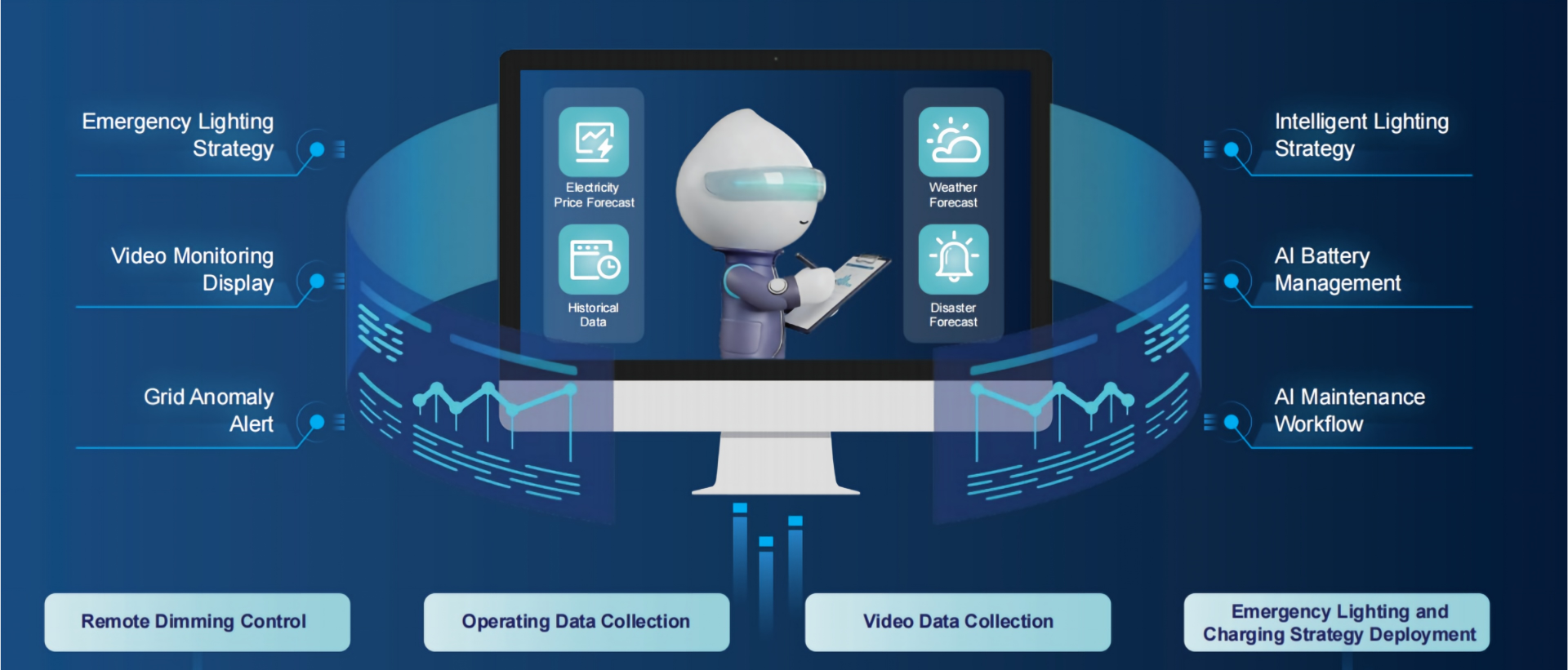
A connected Emergency Energy Storage Roadway Light can use a Data Transmission Unit, or DTU, to collect and transmit data such as voltage, current, power, luminaire status, remaining battery capacity, and battery health.
An AI agent can then combine this information with weather forecasts, road classifications, operating periods, and traffic demand to evaluate current conditions and support more appropriate lighting strategies.
During an outage, AI can also help balance illumination requirements against the remaining operating time. Higher output may be prioritized when visibility is poor or traffic demand remains high. When traffic decreases, the output can be reduced to preserve energy for the hours ahead.
This is different from conventional fixed-time or fixed-power control. Rather than executing the same preset command throughout an event, the system can adjust its strategy according to changing operating conditions.
However, AI should not replace every safety mechanism. Critical functions such as power switching, overcurrent protection, overtemperature protection, short-circuit protection, and electrical leakage protection should remain governed by deterministic hardware and control rules.
AI is better suited to analyzing trends, recognizing anomalies, optimizing operating strategies, and supporting maintenance decisions. This division of responsibilities is more reliable than expecting AI to control every safety-critical action independently.
Keeping the Lights On Is Not the Only Objective
It may be tempting to assume that emergency roadway lighting should remain on under all circumstances. In reality, continuing to supply power may not always be the safest response.
Severe flooding, damaged equipment, or deteriorated cable insulation can introduce additional electrical risks. A resilient lighting system must therefore understand not only how to maintain illumination, but also when to issue an alarm, reduce output, or isolate an abnormal device.
By continuously analyzing grid and luminaire operating parameters, the system can help identify unusual fluctuations and generate alarms or maintenance work orders. Certain software or communication-related faults may also be addressed through remote restart, strategy updates, or over-the-air upgrades, reducing unnecessary field inspections during dangerous weather conditions.
A more appropriate emergency strategy is therefore selective rather than absolute:
· Safe and critical locations receive lighting priority;
· Lower-demand areas operate at reduced output when necessary;
· Potentially unsafe equipment is identified and controlled;
· Fault information is transferred directly into the maintenance workflow.
The objective is not simply to maximize operating time. It is to use the available energy in a way that supports both road safety and system safety.
Giving Roadway Lighting the Ability to Respond
Based on this approach, HPWINNER has incorporated Emergency Energy Storage Roadway Lights into its LED Roadway Light 2.0 system.
Through energy storage driver-controllers, DTUs, and the AI agent Mr. Victor, the system connects luminaire, grid, battery, and Operation & Maintenance data. This enables continuous status monitoring, adaptive emergency lighting strategies, battery health analysis, anomaly detection, and more efficient maintenance coordination.
The aim is not to claim that every roadway light can remain illuminated under every extreme condition. Instead, it is to use limited energy more intelligently, identify potential problems earlier, and preserve essential lighting where it matters most when conventional power is unavailable.
Extreme weather cannot be avoided, and no urban infrastructure can be completely free from risk. Roadway lighting, however, can evolve from passively waiting for grid power to return toward proactive monitoring, adaptive response, and continuous improvement.
In the future, the performance of a roadway lighting system should not be assessed only by how efficiently it operates under normal conditions. It should also be measured by whether it can still sense, decide, and respond when a city needs light the most.
For more information, feel free to contact us.
Phone: +86-0571-8806-1966
E-mail: sales@hpwin.com
Related HPWINNER LED Lights Recommendations