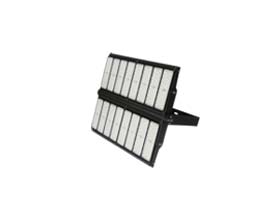
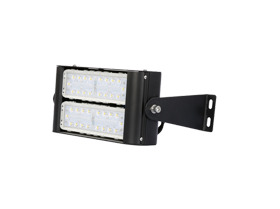
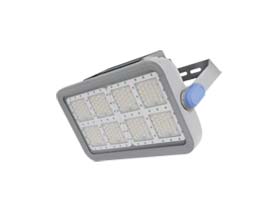
English
  العربية
  中文
中文
 Deutsch
 Türkçe

 日本語
日本語
How to Choose the Best LED High Bay Lights for Your Warehouse: A 2026 Buyer's Guide
Warehouse lighting is no longer a “set it and forget it” utility. In 2026, the best facilities treat lighting as an operations asset—one that impacts safety, picking accuracy, energy spend, and maintenance downtime. If you’re comparing fixtures (and evaluating a led high bay manufacturer), this guide gives you a practical checklist to choose lights that hold performance for 10+ years—not just day one brightness.
Introduction: The High Stakes of Warehouse Lighting
Poor lighting is a hidden cost that shows up in places most teams don’t track well:
Safety risks: darker floors, glare, and shadowing increase near-miss incidents around forklifts and pedestrians.
Energy waste: over-wattage, incorrect beam angles, and no smart controls push bills higher than necessary.
Maintenance shutdowns: changing fixtures 25–40 feet in the air is expensive—and disruptive.
The 2026 standard: smart, modular, and sustainable
Modern industrial LED lighting solutions should deliver:
High luminous efficacy (lm/W)—typically in the 160–180 lm/W range for high-efficiency warehouse lights
Thermal stability to slow lumen depreciation over years
Tool-less maintenance where possible, to reduce lift time and labor cost
Optional smart controls (1–10V dimming, motion sensors) to cut wasted runtime
Step 1: Calculate Your Mounting Height and Lumens (The Basics)
Before comparing brands, get your baseline right: ceiling height, racking layout, and target brightness.
Know your target: Foot-candles (fc)
Foot-candles measure light on the working plane (often the floor). Many warehouses target 20–40 fc, depending on tasks (storage vs. active picking, barcode scanning, QA inspection, etc.). The key is uniformity, not just peak brightness.
15–25 feet: common warehouse heights
For 15–25 ft mounting heights, many projects use:
Wattage: often in the 100W–200W range
Beam angles: 90° or 120° for open areas; tighter optics if you need more punch on the floor
CRI: 70–80 CRI is typically enough for accurate SKU and label reading without overspending
25–40+ feet: avoid “light thinning”
At higher mounting heights, you need:
Higher lumen output (not just higher wattage—efficacy matters)
Narrower beam angles like 60° / 40° / 25° to reduce wasted spill and keep floor-level illumination strong
Consider asymmetric light distribution for aisle/rack layouts to push light where it’s needed, not into the tops of racks
Step 2: Form Factor—UFO vs. Linear vs. Modular (HPWINNER Expertise)
Choosing the right fixture shape affects uniformity, glare, installation, and long-term serviceability.
UFO high bays: fast coverage for open spaces
Pros
Compact, easy to mount
Great for open floor areas (packing zones, staging)
Cons
Can create hot spots if optics don’t match mounting height
Less ideal for long aisles unless optics are tailored
Linear high bays: ideal for racking and aisles
Pros
Better alignment with rack aisles
Often helps reduce shadows between tall shelving rows
Cons
Not always the best fit for wide-open bays unless layout is carefully planned
The modular advantage (future-proof ROI)
A modular LED high bay is increasingly the “2026-ready” choice—especially for large facilities with strict uptime requirements. Why modular wins for total cost of ownership
If one module fails, you replace the module—not the whole fixture
This reduces waste, labor, and downtime (especially at 30–40 ft)
Enables scalable upgrades (optics, drivers, controls) over the fixture’s service life
HPWINNER’s modular approach (e.g., T29 / T65 series) is built around serviceability: the goal is to keep your lighting plan stable while minimizing “whole-unit” replacements.
Step 3: Thermal Management—The Secret to Longevity
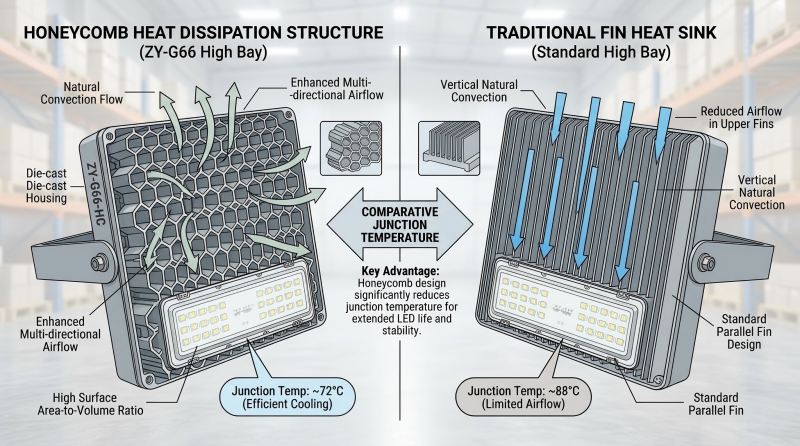
Heat is the #1 performance killer in LED fixtures. When thermal design is weak, junction temperature rises, which accelerates:
Lumen depreciation (the “it got dim after two years” problem)
Driver stress and earlier failures
Color shift and uneven lighting appearance over time
Technical deep-dive: Honeycomb Heat Dissipation Technology
HPWINNER emphasizes Honeycomb Heat Dissipation Technology to increase surface area and airflow efficiency. The practical benefit isn’t just “cooler running”—it’s maintaining stable light output and efficiency longer, helping your fixture stay closer to its rated performance years down the line. If you’re comparing any led high bay manufacturer, ask for thermal design details (not marketing phrases): heat sink structure, materials, and real operating temperature targets under industrial conditions.
Step 4: Maintenance and Tool-less Scalability (What Your Team Will Thank You For)
Lighting maintenance is never just the cost of a part—it’s lift rentals, labor hours, aisle closures, and safety procedures.
Why IP rating and service design matter
For dusty, humid, or washdown-prone areas, look for higher protection ratings. IP68 LED lighting can be a strong fit for harsh environments where you can’t risk ingress-related failures.
Tool-less onsite replacement: the “30 feet in the air” test
Ask a simple people-first question: How easy is it for your facility manager to fix this fixture 30 feet in the air? Tool-less modular replacement can cut:
time at height (safety exposure)
downtime in active aisles
cost per incident when something goes wrong
Why Your Choice of “LED High Bay Manufacturer” Matters
A fixture can look similar on a spec sheet, but manufacturer capabilities determine what happens after installation—especially at scale.
Direct-to-factory benefits (where real optimization happens)
A capable manufacturer can help tailor:
Beam angles: 25°, 40°, 60°, 90°, 120°
Optics for open floor vs high-rack aisles (including asymmetric distributions)
Control options like 1–10V dimming and motion sensors for targeted savings
Retail-only options often force you into “one-size-fits-all,” which can mean overbuying wattage to compensate for poor distribution.
R&D scale and consistency
For projects that demand repeatable quality, manufacturing scale and engineering resources matter. HPWINNER highlights a 333,000 sqm smart factory and 13+ years of manufacturing experience—signals that support consistent output, product iteration, and long-term support for large deployments.
Certifications: a must for industrial compliance
For many facilities, certification requirements are non-negotiable. Look for a manufacturer aligned with global industrial standards such as:
UL
DLC
CE
Quick Comparison Table: What to Look for in a High Bay (2026 Checklist)
| Decision Factor | What “Good” Looks Like in 2026 | Why It Matters |
|---|---|---|
| Efficacy (lm/W) | ~160–180 lm/W | Lower energy cost for the same brightness |
| Optics / Beam Angle | 25°–120° options | Prevents dark spots, glare, and wasted spill |
| Layout Fit | UFO / Linear matched to use case | Better uniformity and aisle visibility |
| Modularity | Replace modules vs whole fixture | Reduces downtime + long-term replacement cost |
| Thermal Design | Advanced heat dissipation (e.g., honeycomb) | Slower dimming and longer service life |
| Protection | IP-rated options (incl. IP68 where needed) | Reliability in dust/humidity/harsh zones |
| Controls | 1–10V dimming, sensors | Cuts wasted runtime and improves sustainability |
| Manufacturer Support | Photometric planning + customization | Better results with fewer fixtures and fewer surprises |
FAQ
How many LED high bays do I need for a 10,000 sq. ft. warehouse?
Typically, for a 20 ft ceiling aiming for 30 foot-candles, you may need about 25–30 fixtures in the 150W–200W range, depending on beam angle, reflectance, and layout. A photometric plan is the fastest way to confirm counts and spacing before purchase.
Conclusion: Future-Proofing Your Facility
If you want lighting that performs beyond the first year, prioritize:
Correct optics for your mounting height and layout
Modularity to reduce replacement cost and downtime
Thermal management to slow lumen depreciation
A proven led high bay manufacturer with certifications and engineering support
Ready to optimize your warehouse layout? Explore HPWINNER’s LED high bay options from a professional led high bay manufacturer or contact their engineers for a custom photometric plan.
Related HPWINNER LED Lights Recommendations