English
  العربية
  中文
中文
 Deutsch
 Türkçe

 日本語
日本語
How LED Tunnel Lighting Eliminates the "Black Hole Effect": A Guide to Driver Safety
Introduction: The Hidden Danger at the Tunnel Entrance
On a bright, sunny day, a tunnel entrance can feel like a split-second “blink”—a moment where the road ahead appears to turn into a dark void. That sensation isn’t just discomfort; it’s a known safety risk called the Black Hole Effect.
The Black Hole Effect describes the human eye’s physiological inability to instantly adapt from high exterior ambient luminance to a comparatively darker tunnel interior. In practical terms, drivers may perceive the entrance as a solid black wall, hesitate, brake suddenly, or miss hazards in the first critical meters.
Modern LED tunnel lighting is no longer “just brighter lamps.” It’s applied optical engineering designed to manage visual adaptation, meet international guidance such as CIE tunnel lighting principles (e.g., CIE 88), and reduce crash risk at the most dangerous part of the tunnel: the entrance.
At HPWINNER, tunnel lighting is engineered as a safety system—built around photometry, glare control, zoning, and intelligent controls aligned with recognized tunnel-lighting practice.
The Science of Visual Adaptation (Why the Black Hole Effect Happens)
Human vision adjusts across very different light levels, but it takes time—especially when moving from bright-to-dark conditions.
Photopic vs. Scotopic Vision (and why it matters in tunnels)
Photopic vision: Daylight, cone-dominant vision (high detail, faster reactions).
Scotopic vision: Low-light, rod-dominant vision (lower detail, slower color perception).
Mesopic range: The transition zone where the eye is adapting—often where risk spikes.
When a driver approaches a tunnel in intense daylight, the eye is “set” for high luminance. If the tunnel threshold zone luminance is too low, the driver’s visual system can’t adapt quickly enough, and contrast collapses—vehicles, debris, lane markings, and workers become harder to detect.
Why this becomes a safety issue:
Reduced visibility increases driver reaction time
Sudden braking at entrances increases rear-end collision risk
Poor contrast can hide hazards until it’s too late
Key technical concept: tunnel entrance lighting is designed around luminance (cd/m²) and perceived contrast—not merely “lumens.”
Zoning: The Five Essential Stages of Tunnel Lighting
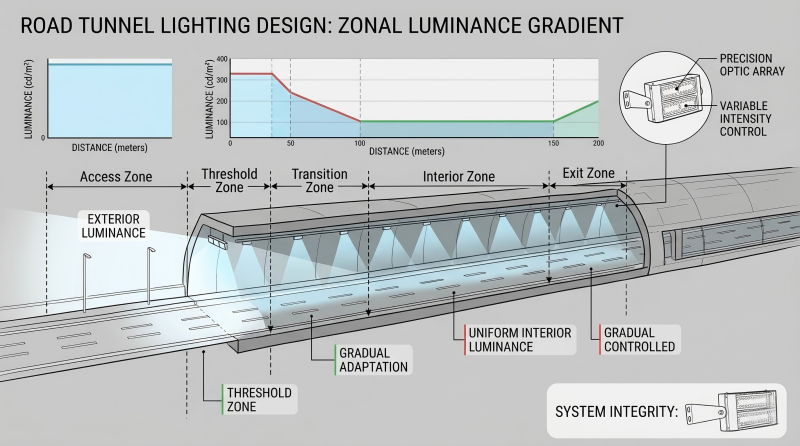
Professional tunnel safety lighting is designed in zones, each with a specific photometric purpose. A well-designed system avoids abrupt changes that trigger the Black Hole Effect (and also reduces glare near exits).
The Five Zones (What they do and why they matter)
Access Zone (Approach)
The roadway before the portal.
Lighting design considers exterior brightness and prepares drivers for the upcoming adaptation.
Threshold Zone (The Critical Area)
The highest luminance region inside/at the entrance.
Purpose: prevent the tunnel from appearing as a “black hole” by matching the driver’s adaptation needs.
Often designed using methods aligned with the L20 concept (an approach based on the driver’s field-of-view luminance near the portal).
Transition Zone
Gradual reduction of luminance from threshold to interior levels.
Purpose: allow controlled adaptation without “step changes” that harm visibility.
Interior Zone
Stable, uniform luminance for comfortable driving.
Focus: uniformity, low glare, and consistent visibility.
Exit Zone
Manages adaptation when leaving the tunnel and reduces risk of the White Hole Effect (glare/discomfort from sudden brightness outside).
Helps drivers re-adapt smoothly to daylight conditions.
Why HPWINNER’s modular approach matters:
HPWINNER’s modular LED tunnel lighting design supports precise photometric “tuning” per zone—making it easier to apply different optics, wattages, and control strategies exactly where needed, rather than over-lighting the whole tunnel.
Technical Solutions: How HPWINNER LEDs Solve the Problem
1) High Uniformity (because “patchy” lighting is dangerous)
Uneven lighting creates bright and dark patches that reduce contrast and can cause visual fatigue. In tunnels, this is not just an aesthetic issue—it affects hazard detection and speed consistency.
HPWINNER fixtures are engineered to deliver smooth light distribution with optics designed for roadway geometries, supporting better uniformity through:
Purpose-built beam angles for tunnel mounting heights
Consistent photometric output across fixture arrays
Better visibility of lane markings and obstacles
2) Anti-Glare LED Optics (good lighting should not blind the driver)
Glare can reduce contrast as severely as insufficient light. Poor glare control can cause discomfort, squinting, and delayed hazard recognition.
HPWINNER addresses this with anti-glare optical lens designs that:
Control high-angle light
Reduce direct view of intense LED sources
Improve visual comfort while maintaining required luminance on the roadway
3) Color Rendering Index (CRI) for faster recognition
In a tunnel, drivers need to identify hazards quickly—vehicles, signage, debris, and sometimes pedestrians or maintenance crews.
Higher-quality LED lighting with an appropriate CRI helps drivers perceive more natural color differences, improving:
Object recognition
Sign legibility
Overall situational awareness
4) Intelligent Control (Smart Tunnel Lighting)
Exterior conditions change constantly—sun angle, clouds, rain, snow, fog, time of day. A fixed lighting level can either underperform (unsafe) or overperform (wasted energy).
HPWINNER supports smart control strategies that can adjust lighting based on real-time conditions, helping maintain safety targets while optimizing energy use:
Brighten the threshold zone when exterior luminance is high
Dim appropriately when exterior conditions are low-light
Stabilize lighting output for consistent visibility and reduced flicker risk
Beyond Safety: The Economic Advantage of LED
Energy efficiency: LED vs. legacy tunnel lighting
Many tunnels still operate with older technologies like HPS (High-Pressure Sodium). Modern LED systems typically deliver major efficiency gains while improving visibility and control.
Benefits commonly include:
Lower energy consumption through higher efficacy
Zoning + dimming = additional savings
Better light control means less wasted light
Maintenance advantages in harsh tunnel environments
Tunnels are demanding:
Moisture and standing water risk
Dust and exhaust particulates
Vibration from constant traffic
Limited maintenance windows (lane closures are costly)
Robust tunnel luminaires designed with strong ingress and impact protection (commonly referenced by IP and IK ratings such as IP68 / IK08 in industrial contexts) help reduce:
Failure rates
Emergency callouts
Lane closure time and associated traffic management costs
Conclusion: Engineering a Safer Journey
The Black Hole Effect is not inevitable—it’s a solvable engineering challenge. When tunnel lighting is designed around visual adaptation, correct zoning, strong uniformity, and rigorous glare control, drivers gain the time and contrast they need to perceive hazards and respond safely.
Safety in infrastructure starts with the right lighting partner—one that treats lighting as an optical system, not just a fixture.
Talk to HPWINNER About Your Tunnel Lighting Design
Planning a tunnel infrastructure project? View the full technical specifications of HPWINNER LED Tunnel Lights or contact our engineering team for a lighting simulation.
FAQ
What is the black hole effect in tunnels?
The black hole effect occurs when drivers approach a tunnel from bright daylight and the entrance appears extremely dark due to the eye’s slow adaptation from high to low luminance. This reduces contrast and can delay hazard detection at the portal.
What are the lighting requirements for tunnels?
Tunnel lighting is typically designed by zones (access, threshold, transition, interior, exit) and follows established engineering guidance (commonly aligned with CIE tunnel lighting principles). The aim is to provide sufficient entrance luminance, strong uniformity, controlled glare, and smooth transitions for visual adaptation.
How many lumens are needed for tunnel entrance lighting?
There is no universal lumen number for all tunnels because entrance lighting is designed primarily around luminance (cd/m²), geometry, surface reflectance, speed, and exterior conditions (often assessed via concepts like L20). A lighting simulation is the correct way to determine fixture quantities and lumen packages for a specific tunnel.
Related HPWINNER LED Lights Recommendations