English
  العربية
  中文
中文
 Deutsch
 Türkçe

 日本語
日本語
How to Evaluate LED Stadium Lighting Manufacturers: A Checklist for Project Managers
For project managers and stadium facility operators, the choice of a lighting partner is a high-stakes decision. A sports venue is more than just a space; it is a performance infrastructure that must meet international broadcast standards, ensure athlete safety, and withstand decades of operation. When searching for the right LED stadium lights manufacturers, it is easy to get lost in a sea of technical jargon and price quotes.
However, not all lighting providers are created equal. As global standards for sports broadcasting—such as the UEFA Stadium Lighting Guide—become increasingly stringent, selecting the right LED stadium lights factory is the difference between a project that succeeds and one that faces costly rework.
This guide provides a systematic checklist to help you evaluate potential partners, ensuring you choose a supplier capable of delivering professional-grade solutions.
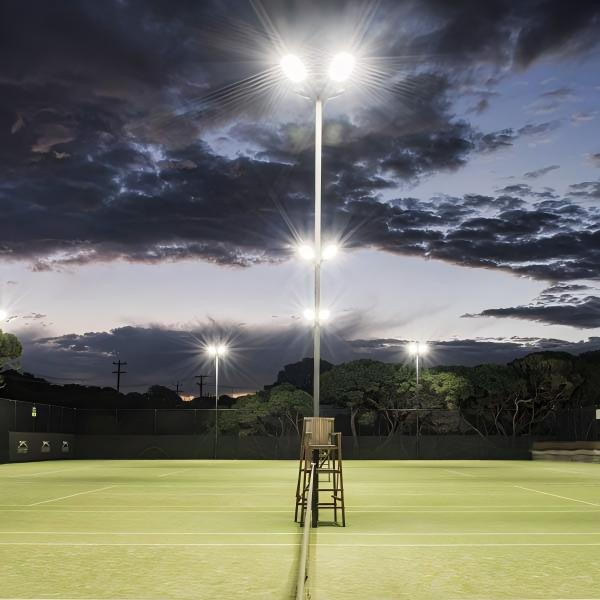
Key Criteria for Evaluating LED Stadium Lighting Manufacturers
When evaluating a partner, you must look beyond the initial spec sheet. Professional sports lighting is a multidisciplinary challenge involving optics, thermal management, structural engineering, and software control. A reliable LED stadium lights manufacturer should act as an extension of your own project team.
Use this Project Manager’s Evaluation Checklist to ensure you are covering all mission-critical performance requirements:
| Evaluation Category | Mission-Critical Capability |
|---|---|
| Photometrics | Provides professional DIALux simulation reports |
| Thermal Strategy | Patented whole-structure heat dissipation design |
| Durability | IP68-rated optics and marine-grade corrosion resistance |
| Broadcast Ready | Guaranteed flicker-free performance (at 300fps+) |
| Track Record | Verified global project references |
| Maintenance | Tool-free, modular component replacement |
Product Quality, Performance & Technology Standards
Performance in a stadium environment is measured by more than just raw lumen output. True quality is defined by consistency, precision, and durability.
Photometric Precision: A professional supplier must offer advanced optical design. The goal is to maximize vertical illuminance for cameras while minimizing glare and light spill.
Flicker Control: For venues broadcasting at 300+ frames per second, flicker must be kept below 3%. An experienced LED stadium lights factory will utilize high-end driver technology to ensure seamless slow-motion replay.
System Reliability: Look for companies that employ patented modular light engines. These features ensure that the system remains operational in extreme conditions—from high-humidity coastal ports to arid inland stadiums.
Explore our advanced LED lighting technology and product series here.
Manufacturing Capabilities and Quality Control Processes
The difference between a mass-market product and a stadium-grade luminaire often lies in the factory floor. When you partner with a top-tier LED stadium lights manufacturer, you are buying into their quality control (QC) ecosystem.
A world-class LED stadium lights factory should demonstrate comprehensive testing capabilities, including thermal load testing, environmental stress testing for corrosion, and end-to-end supply chain control. By managing everything from aluminum die-casting to final optical assembly, the manufacturer ensures that the product you receive matches the performance promised in the simulation report.
Pricing, Value and Total Cost of Ownership
It is common to focus on the initial purchase price, but for a stadium project, the Total Cost of Ownership (TCO) is the true metric of value. A cheaper product may save 10% on the upfront investment but cost 50% more in maintenance, energy, and labor over a 5-year period.
When evaluating LED stadium lights manufacturers, calculate the TCO by considering maintenance expenses (modular vs. sealed systems), energy efficiency modes, and the projected lumen depreciation rate over 50,000 hours of operation.
After-Sales Support, Warranty and Project Delivery Experience
A stadium project does not end when the lights are shipped. Professional support during the installation—focusing on laser-aiming and system commissioning—is critical.
HPWINNER has a history of successful partnerships on a global scale, supporting complex projects in regions like Australia, Pakistan, and Ukraine. Our commitment extends beyond the factory gate; we provide the engineering documentation, installation guidance, and performance validation required to ensure the venue meets its intended lighting classification.
When you work with a trusted LED stadium lights factory, you gain a partner dedicated to your project's long-term success. Whether you need technical input for a retrofit or a design for a new build, contact our engineering team to discuss your project requirements.
Conclusion
Selecting the right partner from the many LED stadium lights manufacturers available today is a strategic decision that affects the safety, utility, and reputation of your venue. By using this checklist—focusing on product performance, manufacturing rigor, TCO, and post-sale support—you can ensure your project delivers world-class results.
Modern stadium lighting is no longer a commodity; it is a precision-engineered performance infrastructure. By prioritizing reliability and partnering with manufacturers who specialize in high-mast, broadcast-ready solutions, you create a lasting legacy for your community and athletes alike.
Frequently Asked Questions (FAQ)
1. Why is a photometric study essential for stadium projects? A photometric study (DIALux) ensures that light is distributed evenly across the pitch, eliminating dark spots and glare, which is critical for athlete performance and high-speed broadcast cameras.
2. What should I look for when comparing LED stadium lights manufacturers? Look for their ability to provide custom optical solutions, evidence of rigorous thermal testing, experience with international compliance standards, and a proven track record of successful high-mast project completions.
3. Does the "factory-direct" model offer significant advantages? Yes. Purchasing directly from a qualified LED stadium lights factory ensures better price transparency, direct access to engineering expertise, and faster response times for technical support or warranty claims.
4. How does modularity benefit stadium lighting maintenance? Modular designs allow for individual light engine or driver replacement rather than replacing an entire fixture, significantly reducing high-altitude labor costs and stadium downtime.
Related HPWINNER LED Lights Recommendations