English
  العربية
  中文
中文
 Deutsch
 Türkçe

 日本語
日本語
The Engineering Behind the Build: A Deep Dive into a Professional Smart LED Flood Light Factory
Walk onto a coastal harbor at night and you’ll see the problem immediately: salt-laden air, constant wind-driven moisture, and long operating hours that punish anything “standard.” Now move that same lighting requirement to a high-vibration mining site—dust, shock, heat cycling, and maintenance teams who don’t have time to baby fixtures that were never engineered for real-world extremes.
That’s why a smart LED flood light factory can’t just be a place that assembles housings and drivers. It must be an engineering system—where optical science, sealing physics, thermal design, and smart controls are built into every step of manufacturing. At HPWINNER, this mindset is baked into the organization. The factory’s R&D roots—founded by PhDs from the Institute of Optics and Electronics (CAS)—reflect a practical bridge between academic-grade optics research and the demands of industrial lighting in harsh environments.
Why “Standard” Waterproofing Fails in Extreme Environments
Most buyers start with an IP rating (IP65, IP66) and assume the job is done. In mild conditions, that’s often enough. In high-humidity, coastal, or high-thermal-swing environments, it frequently isn’t.
The real failure mechanism: “breathing” + seal fatigue
Even well-made fixtures experience thermal expansion and contraction. As the luminaire heats up during operation and cools down when off, pressure changes can cause micro “breathing.” Over time, moisture vapor can be pulled into weak points—especially around screw holes, interfaces, and aging gasket paths. People Also Ask: Why do LED flood lights fail in high-humidity areas?
Because humidity isn’t just “water outside the fixture.” It becomes water vapor ingress, then condensation, then corrosion—often accelerated by heat and electrochemical reactions on the PCB, connectors, or driver components. Add salt air and the process speeds up.
What to look for beyond an IP label
Thermal management: hot components drive pressure cycling and condensation risk
Moisture ingress paths: screws, seams, cable glands, lens interfaces
Seal degradation: UV exposure, compression set, chemical exposure over time
In short: IP65/66 can be “water-resistant” in a test, but still underperform in continuous, punishing field conditions.
The HPWINNER Advantage: Patented IP68 “Double-Coupling” Technology
If the failure points are interfaces and fasteners, the logical response is to engineer the interface so it doesn’t rely on the common weak spots.
The technical idea: screw-free sealing that stays stable
HPWINNER’s approach centers on a patented IP68 “double-coupling” structure using a screw-free design philosophy where double silicon rubber rings form a complete insulation barrier around critical internals—especially the LED chip and PCB. Instead of relying on:
heavy glue application (which can age, crack, or become inconsistent in mass production), or
external gaskets that can lose compression and allow micro-leaks,
…the sealing concept is engineered as a repeatable mechanical system designed to prevent vapor pathways and reduce corrosion risk over the long term.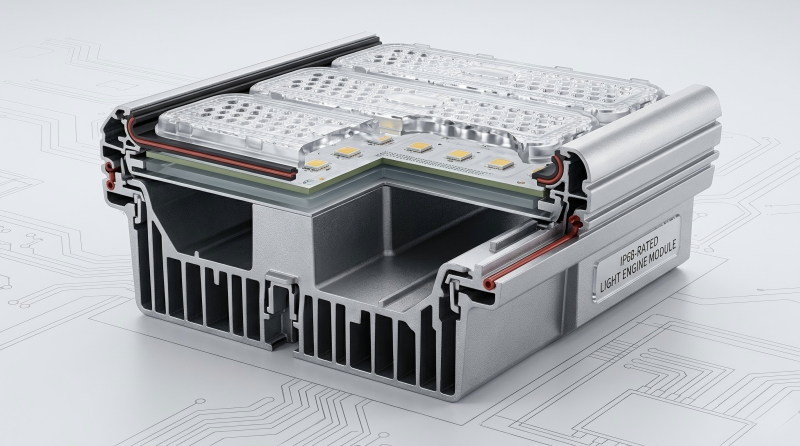
Scaling Intelligence: How Modern Factories Integrate IoT into Flood Lighting
Industrial buyers increasingly need more than brightness—they need visibility, control, and reporting.
From “on/off” to spatial interconnection
Smart flood lighting is evolving toward Spatial Interconnection: lights communicating with platforms and with each other to respond to real conditions—occupancy, schedules, ambient light, safety zones, and equipment movement.
What factory-level IoT integration changes
When a manufacturer can integrate control options at the assembly stage, the result is a cleaner, more reliable system (and fewer field retrofits). A modern smart LED flood light factory should be able to support common protocols and controls such as:
Zigbee for mesh-based smart infrastructure deployments
DALI for professional lighting control and centralized management
AI-driven sensors for adaptive brightness, presence detection, and operational logic
Practical outcomes for industrial sites and smart cities
remote dimming and scheduling
adaptive brightness tied to safety requirements
energy reporting for ESG/low-carbon lighting solutions
centralized maintenance alerts (reducing emergency truck rolls)
People Also Ask: Can smart flood lights be integrated into existing Smart City platforms?
Yes—when the fixture control layer supports standard protocols and the factory can configure sensor/control modules consistently, integration is typically handled through gateways, controllers, or platform APIs already used in smart city infrastructure.
Beyond the Specs: The Value of 300+ Optical Distributions
Many suppliers offer only a few beam angles. That’s fine for generic yards—but it breaks down in high-stakes applications where glare control, spill light, and uniformity define safety and compliance.
Why optical distribution is a “factory capability,” not a catalog line
A professional R&D manufacturer can support 300+ optical distributions because optics aren’t an afterthought—they’re designed, tested, and validated as part of a system (lens, reflector, LED arrangement, thermal path, and mounting geometry).
Application examples where optics matter
Stadiums: reduce spill and light pollution while maintaining uniformity
Airports: high-precision distribution to improve visibility and safety on aprons/taxiways
Ports and harbors: long-throw, controlled glare patterns for crane and perimeter lighting
Mining and heavy industry: minimize harsh glare and improve hazard detection
This is where a factory-direct relationship becomes strategic: you’re not buying “a beam angle,” you’re buying the correct distribution for your site geometry.
Maintenance Reimagined: The Tool-less Revolution
Reliability is only half the story. The other half is what happens when something eventually needs service.
Tool-less onsite replacement of light engines
HPWINNER’s tool-less onsite replacement concept rethinks the maintenance workflow around the people doing the job—often at height, in wind, in constrained spaces, and under strict safety procedures. This is “people-first” engineering in industrial lighting:
fewer steps in risky conditions
shorter downtime windows
less chance of installation error during service
faster return to compliant illumination levels
Business impact: lower Total Cost of Ownership (TCO)
For B2B buyers, maintenance efficiency often outweighs small differences in initial fixture price. Tool-less replacement can reduce:
labor hours per service event
equipment rental time (lifts, closures, permits)
lost productivity from downtime
spare parts complexity (standardized modules)
FAQ: IP Ratings, Heat, and Lifespan (PAA Answers)
What is the difference between IP67 and IP68 for industrial flood lights?
In general terms, IP67 is designed for temporary immersion, while IP68 indicates suitability for continuous immersion under conditions specified by the manufacturer. For industrial flood lighting, the bigger practical difference is often the sealing architecture and long-term vapor resistance, not just the label.
How does heat dissipation affect the lifespan of a smart LED?
Heat accelerates degradation across the system: LED lumen maintenance, driver lifespan, seal aging, and condensation cycles. Strong thermal management (often via die-cast aluminum housing and optimized thermal paths) supports stable performance and reduces failure risk.
What certifications should industrial buyers look for?
Depending on project region and requirements, buyers commonly evaluate third-party validation such as SGS and TUV certification, and lab/testing capabilities aligned with performance, safety, and reliability expectations.
Conclusion: Choosing a Factory Partner for the Next Decade
Extreme environments expose every shortcut: screw holes that “breathe,” gaskets that fatigue, glue that ages, optics that don’t match the site, and smart controls that were bolted on too late. The new gold standard is the combination of:
engineered IP68 protection (designed to prevent vapor and corrosion pathways), and
factory-integrated IoT capability (Zigbee/DALI/sensors built into production), and
optical depth (hundreds of distributions for real-world precision), and
maintenance-friendly modularity (tool-less light engine replacement for safer, faster service)
Consult with our R&D engineers to calculate the precise lighting distribution for your next extreme environment project—and specify a solution that performs on paper and on the factory floor. Contact us now!
Related HPWINNER LED Lights Recommendations